
How to Read Your Electricity Bill in Pakistan (Slabs, Taxes & FPA Explained)
 Written by
Naveed Shahid
· naveedshahid@solarguide.pk
Published 8 Jul 2026 · updated 13 Sep 2026
Every month, the same ritual: the bill arrives, the number is higher than you expected, and nobody can quite explain why. The units went up a little – but the bill went up a lot. If that sounds familiar, you’re not imagining it. Pakistani electricity bills are genuinely confusing by design: your final amount is built from slab rates, fuel adjustments, quarterly adjustments, duties, and taxes, all stacked on top of each other in fine print.
This guide walks through every line of that bill in plain language – what each charge is, why it exists, and which ones you can actually do something about.
And if you’re thinking about solar, understanding your bill is step zero. The slab system means the last units you consume each month are by far your most expensive – which is exactly why cutting even part of your consumption with solar saves disproportionately more than you’d expect. More on that at the end.
The anatomy of your bill
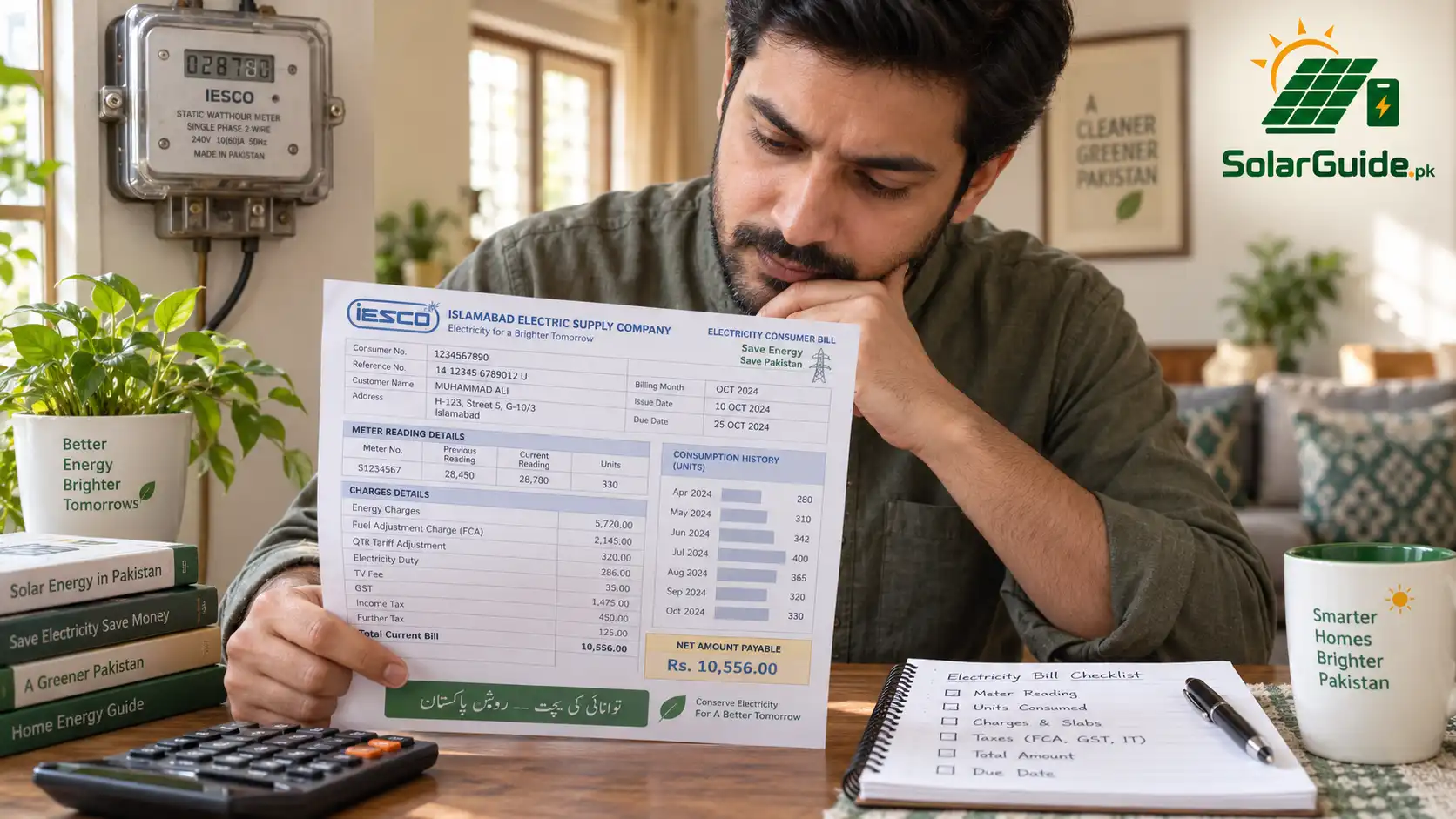
Whether yours comes from LESCO, K-Electric, IESCO, MEPCO or any other DISCO, the layout is broadly the same. Here’s what each section means:
Units consumed (kWh). The single most important number on the page. It’s your current meter reading minus last month’s reading. One “unit” is one kilowatt-hour – roughly what a ceiling fan uses in ten hours, or a 1-ton inverter AC uses in about one hour of steady running.
Reading and billing dates. Check these. If your “reading date” gap is longer than usual – say 35 days instead of 30 – you may have been pushed into a higher slab purely because more days were counted. Billing-period stretching is one of the most common causes of surprise bills, and you can dispute it.
Tariff / consumer category. Usually “A-1” or similar for domestic connections. This determines which rate table applies to you.
The charges block. This is where the real story is – energy charges, FPA, adjustments, duties and taxes. The rest of this guide breaks it down line by line.
Tariff slabs: why your rate isn’t one rate
Pakistan prices domestic electricity in slabs, bands of consumption that each carry a different per-unit rate. Use few units, pay a low rate; use more, and the additional units are charged at progressively steeper rates. The exact rates are set by NEPRA and revised periodically, and your bill prints the current table on it, so we’ll use simple illustrative numbers here rather than rates that will be outdated in three months.
The crucial, and painful, quirk of the Pakistani system is the previous-slab benefit rule: as your consumption crosses into higher slabs, you don’t keep the cheap rates for all your earlier units. Under the rules, a consumer generally gets the benefit of only one previous slab. In practice this means crossing a slab boundary by even a handful of units can re-price a large chunk of your consumption at a higher rate, which is why a 10% increase in units can produce a 25% increase in the bill.
Protected vs unprotected consumers
There are two classes of domestic consumer, and the difference is worth real money. Protected consumers, broadly, those who have stayed at or below 200 units per month for six consecutive months, get substantially subsidised slab rates. Unprotected consumers pay the full rates.
One heavy month can cost you far more than that month’s bill. If you cross the 200-unit line even once, you lose protected status, and you only regain it after another six consecutive months at or under the threshold. A single July of extra AC use can raise your rates until well into winter. If you hover near the line, this alone is a strong argument for a small solar setup to keep your grid units under the threshold.
FPA, QTA and the rest of the fine print
Below the energy charges, your bill collects a series of adjustments and taxes. In rough order of impact:
Fuel Price Adjustment (FPA / FCA). Power plants’ fuel costs change monthly; the difference between assumed and actual fuel cost is passed to you as a per-unit adjustment, usually reflecting fuel prices from about two months earlier. It can be positive or negative – in months when fuel was cheap or hydel generation was high, you’ll occasionally see FPA as a credit. This is the line that makes two bills with identical units differ from month to month.
Quarterly Tariff Adjustment (QTA). Similar idea, applied quarterly, covering broader cost true-ups. Appears as its own per-unit line.
Electricity Duty. A provincial levy calculated as a percentage of your variable charges.
General Sales Tax (GST). Federal sales tax applied to your electricity charges. Because it’s a percentage of everything above it, every other increase quietly increases your GST too.
PTV licence fee. A flat fee collected for the state broadcaster, a small fixed amount on domestic bills.
Other surcharges. Depending on the period and your DISCO, you may see a financing-cost surcharge or similar per-unit levies. These change with government policy; the bill’s own line items are the source of truth.
Quick sanity check for any bill: divide the total amount by units consumed. That’s your true blended rate per unit – taxes, adjustments and all. Most unprotected urban households are shocked to discover their real rate is 30–50% higher than the “slab rate” they thought they were paying. Remember this blended number: it’s the honest figure to use when you calculate what solar would save you.
A worked example
Say a Lahore household uses 450 units in August. Using deliberately simplified rates for readability (your bill’s printed table has the current ones):
| Line | Calculation (illustrative) | Amount |
|---|---|---|
| Slab 1 – first 100 units | 100 × Rs 10 | Rs 1,000 |
| Slab 2 – next 200 units | 200 × Rs 18 | Rs 3,600 |
| Slab 3 – remaining 150 units | 150 × Rs 26 | Rs 3,900 |
| FPA | 450 × Rs 2.50 | Rs 1,125 |
| Duties + GST + fees | on the above | Rs 1,900 |
| Total | ≈ Rs 11,525 |
Notice two things. First, the last 150 units cost nearly as much as the first 300 combined. Second, almost Rs 3,000 of this bill isn’t electricity at all – it’s adjustments and taxes riding on top. (Rates above are rounded for clarity, not current NEPRA rates – the mechanics, not the maths, are the point.)
Why this matters if you’re going solar
Here’s the insight most installers never explain properly: solar doesn’t erase your average units – it erases your most expensive ones first.
Because of the slab ladder, the units at the top of your consumption are the ones charged at the highest rate, carrying the most FPA and the most GST. A solar system sized to cover even 60–70% of your usage doesn’t just cut your bill by 60–70% – it wipes out the expensive slabs, may drop your remaining grid units into cheaper bands, and can even bring a borderline household back under the protected threshold. The savings compound in your favour.
That’s also the honest way to evaluate any solar quote: don’t ask “what’s my average rate,” ask “what do my last 300 units cost me?” – because those are the ones the panels will replace.
If you want the numbers for your own house: our solar system size calculator turns your monthly bill into a recommended system size, and the savings and payback calculator shows what it earns over 25 years. If you export extra units to the grid, net billing improves the maths further, though less than net metering once did – the guide covers the current rules and rates. And when you’re ready for real numbers from real installers, get three competing quotes and compare them against each other.
Your bill has been telling you a story every month. Now you can read it.
Writes our net metering and grid connection guides. Builds grid stations and transmission lines for a living.