
Net metering in Pakistan: rules, rates and whether it’s still worth it
Solar net metering in Pakistan changed on 9 February 2026. NEPRA scrapped the old one-to-one system and brought in net billing under the Prosumer Regulations 2026. If you already hold a net metering agreement, your old rate is safe until your contract ends. If you apply today, you sell surplus power at Rs 8.13 per unit instead of the old Rs 25.32. This guide covers what net metering is, what changed, the current rates side by side, and whether solar still pays off for your home or business.
What Is Net Metering in Solar?
Net metering lets your rooftop solar system push extra electricity back to the grid. Your meter runs both ways. During the day your panels often make more than your home needs. That surplus flows out to the grid and earns you credit. At night, or when clouds roll in, you pull power back.
Under the classic system one exported unit cancelled one imported unit. That was the whole appeal. Plenty of Pakistani homes ran their bills down to almost nothing.
How Net Metering Works in a Solar System
The core of the setup is a bidirectional meter. It tracks two numbers. Units you send out, and units you take in. Your DISCO settles the difference on your monthly bill.
You need an on-grid or hybrid inverter to make this work. A pure off-grid inverter cannot feed the grid safely. The inverter also carries anti-islanding protection. This cuts your export the moment the grid goes down, so linemen working the line stay safe.
Here is the bit most people skip over. Net metering never pays you for the power you use yourself. It only deals with the leftover. So a system matched to your own daytime load beats a giant array dumping units onto the grid.

Net Metering vs. Net Billing: What Changed in 2026
This is the biggest shift in Pakistani solar since 2015. Read this part twice.
Old net metering worked like a swap. You exported a unit, you got a full retail unit back. Import and export sat at the same rate.
Net billing splits those two apart. You sell your surplus at a low wholesale rate. You buy grid power at the full retail rate. The gap between them is now huge.
Under net billing your export earns Rs 8.13 per unit. Your import still costs Rs 40 to 55 per unit. That spread is why the maths flipped for everyone applying now.
My honest take? Net billing does not kill solar. It kills the trick of treating the grid as a free battery. Self-consumption rules everything now.

On-Grid Solar With or Without Net Metering
People often ask if they can run on-grid solar without net metering. You can. Your panels still slash your daytime bill. But with no agreement, any surplus you export earns you zero. You hand it to the grid for free.
For a home that burns most of its power after sunset, on-grid without net metering wastes the best hours of production. A hybrid setup with batteries suits that pattern far better today.
Solar Net Metering Policy in Pakistan (NEPRA Rules)
Policy moved at a sprint in early 2026. Let me walk you through what happened and when.
The 2026 Rate Reduction: What Actually Happened
For years the buyback rate held near Rs 25 to 27 per unit. Rooftop solar exploded. By late 2025 hundreds of thousands of consumers ran net metering across the country. NEPRA and the Power Division argued this pushed costs onto grid-only users.
So they cut the rate. Hard. New consumers now get the National Average Energy Purchase Price, known as NAEPP. NEPRA set it at Rs 8.13 per unit for calendar year 2026. One Member of Parliament called it a drop of Rs 17.19 per unit. Roughly a two-thirds cut in a single move.
Why Did NEPRA Cut the Net Metering Rate?
NEPRA gave three main reasons, and it is worth knowing them before you form a view.
Large solar plants now sell power to the grid for under Rs 10 per unit. Paying rooftop owners Rs 25 to 27 looked out of step with that.
The Power Division said the cost of buying pricey rooftop export was spread across all 38 million grid consumers. It argued that was unfair to families without solar.
Payments to power plants stay fixed whether the grid uses them or not. As solar homes pulled less from the grid, that fixed burden shifted onto everyone else.
You can agree or disagree with the logic. Many solar owners feel punished for an investment the state once encouraged. But knowing the reasoning helps you plan around it instead of just being angry at it.
Prosumer Regulations 2026 Explained
On 9 February 2026 NEPRA notified the Prosumer Regulations 2026 through SRO 251(I)/2026. These rules repealed the decade-old Net Metering Regulations 2015.
The word “prosumer” simply means producer plus consumer. The rules cover solar, wind, and biogas systems up to 1 MW. Here are the core changes at a glance.
- Export now pays at NAEPP, not the retail rate you pay
- Contracts run five years, down from seven
- System size caps at your sanctioned load, cut from 1.5 times
- Billing moves from net metering to net billing

Existing vs. New Consumers: Who Is Protected
This part sparked panic, then relief. Let me settle it once and for all.
The first notification looked like it hit everyone, old and new. The backlash was loud. Prime Minister Shehbaz Sharif stepped in within days. He ordered the Power Division to protect existing contracts and file a review with NEPRA.
On 16 February 2026 NEPRA floated a draft amendment covering consumers who held a valid net metering licence on 9 February 2026. The protection does not actually rest on that draft. It is already written into the 9 February regulations themselves. The transitional clause says that generators holding valid agreements executed under the repealed 2015 rules continue to be billed at the national average power purchase price until the term of that agreement expires, moving to the new rate only on renewal. If that describes you, your old rate and one-to-one exchange stay in place until your contract ends. New applicants fall fully under net billing.
Power Minister Awais Leghari confirmed that 5,165 applications filed before 8 February 2026 will also get the old policy. That group is the one genuinely worth checking, because those applicants had applied but not yet signed an agreement, so the transitional clause above does not automatically cover them. Get your DISCO to confirm your status in writing before you commit.
Current Solar Net Metering Rates and Buyback Tariff
Rates are why you opened this page. Let me lay the numbers out plainly.
Exports are credited at the National Average Energy Purchase Price, set at Rs 8.13 per kWh for calendar year 2026 in NEPRA’s decision of 7 January 2026 on the power purchase price forecast. Anyone whose agreement was signed before 9 February 2026 keeps the older rate of Rs 25.32 until their term expires. Note also that a DISCO cannot accept your application at all once distributed generation on your distribution transformer reaches 80 per cent of its rated capacity.
NAEPP Buyback Rate: Latest Figures
Here is the comparison that matters most in 2026.
| Feature | Existing consumer protected | New consumer from 9 Feb 2026 |
|---|---|---|
| Buyback rate | Rs 25.32 per unit NAPPP | Rs 8.13 per unit NAEPP, CY 2026 |
| Billing type | Net metering one for one | Net billing priced separately |
| Contract length | 7 years | 5 years renewable |
| Size limit | 1.5x sanctioned load | 1x sanctioned load |
| Export settlement | Adjusted monthly | Carried forward, or paid quarterly |
Both rates come from NEPRA’s decision of 7 January 2026 on the CY 2026 power purchase price forecast, which puts the National Average Power Purchase Price at Rs 25.32 per kWh and the National Average Energy Purchase Price at Rs 8.13. The NAEPP is not fixed for your term: regulation 14(3) lets the Authority revise it during your agreement, and the new rate is then treated as part of it.
One warning. The NAEPP is not locked for your whole term. NEPRA can revise it during your contract. That adds a risk the old fixed rate never carried.
Solar Net Metering Bill Example (IESCO)
Let me show you real numbers using IESCO, which serves Islamabad and Rawalpindi. IESCO domestic rates run from about Rs 22 per unit in the lower slabs to Rs 48 per unit at the top end.
Case 1: A 10kW Home in Islamabad
Take Mr. IKRAM house in G-11 with a 10kW system. It generates 1,200 units a month. They use 800 units directly and export 400.
As a protected existing consumer:
- 400 exported units credited near the retail rate
- At about Rs 42 per unit, that is Rs 16,800 in credit
- 800 self-consumed units save Rs 33,600 at Rs 42
- Total monthly benefit: about Rs 50,400
As a new net billing consumer:
- 400 exported units at Rs 8.13 equals Rs 3,252 credit
- 800 self-consumed units still save Rs 33,600
- Total monthly benefit: about Rs 36,850
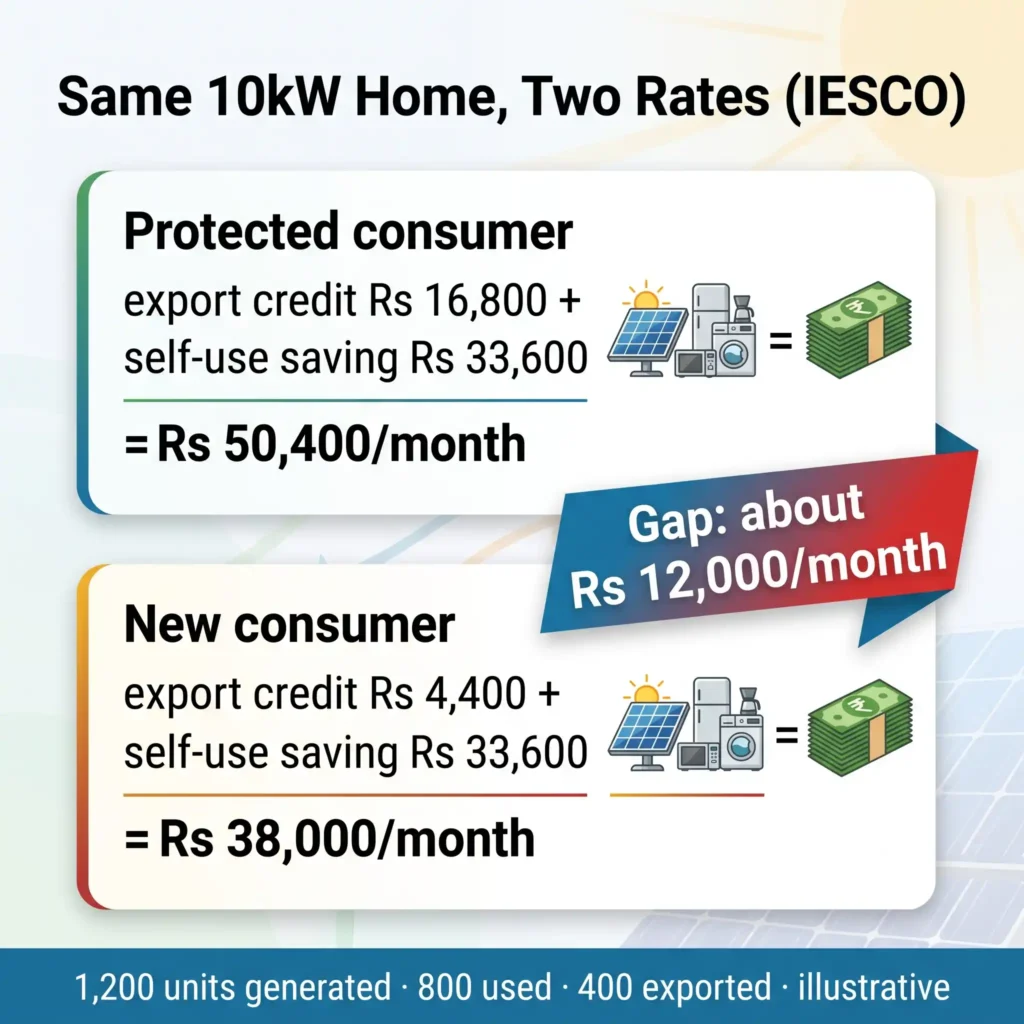
Same system. Same rooftop. Same sun. A gap of roughly Rs 13,500 a month. That is the price of the policy change on one household.
Now notice the real lesson. Most of the benefit comes from self-consumption, not from export. That stays true under both systems.
Case 2: A 5kW Home in Attock
WAQAS AWAN family runs a 5kW system in Attock and generates 600 units a month. They use 480 and export 120. Under net billing their export credit is barely Rs 976. But their self-consumption still saves close to Rs 20,000. For them the export cut barely stings, because they sized the system for their own use.
Case 3: A Small Shop in Rawalpindi
RAJA Wajahat cloth shop in SADAR, runs on commercial tariff pays even more per unit. It runs a 6kW system during business hours and uses nearly everything it makes. Almost zero export. Almost zero loss from net billing. This is exactly the profile that still wins big in 2026. Daytime load, high tariff, low export.
See the pattern across all three? The more power you use while the sun is up, the less the new rules hurt you.
Net Metering and Sales Tax
Tax rules on solar shift often in Pakistan. Budget season brings surprises almost every year. Check the current sales tax position on panels and inverters before you buy. Import duties and GST can swing your total system cost by a real margin. Ask your installer for a written quote that splits equipment, tax, and labour into separate lines. Never accept a single lump-sum figure.
Is Solar Net Metering Still Worth It in Pakistan?
Short answer? Yes, for most homes and businesses. But the reason has changed.
You no longer profit by exporting power. You profit by not buying expensive grid units. With tariffs near Rs 42 to 55 per unit, every unit your panels cover is a unit you skip paying for. That saving is bigger than any export credit ever was.
Updated Payback Period Under Net Billing
Under the old net metering rules, a well-sized system paid back in three to four years. Under net billing, plan for four to seven years for a home built around self-consumption.
Here is where I push back on the doom talk. Payback stretched, yes. But electricity keeps getting more expensive every year. A system that pays back in six years still runs almost free for another fifteen. Your panels carry a 25-year output warranty.
The design rule for 2026 is simple. Size for your daytime load. Add batteries if your evenings run heavy. Stop chasing export credit. Run your own figures in the savings calculator further up this page before you commit a single rupee.
Who Should Still Apply in 2026?
Not every home benefits equally now. Let me be blunt about who wins and who should think twice.
You should still go solar if you use serious power during daylight. That means daytime ACs, a home office, a shop, a clinic, or a factory. Your self-consumption savings will dwarf the lost export credit.
You should size carefully, and probably add batteries, if your load is mostly at night. Exporting cheap and buying back dear is a losing trade under net billing. Storing your own units makes more sense.
You should still apply even without export dreams if your bills are high. Cutting a Rs 60,000 monthly bill by half is a strong return, export credit or not. The grid tariff is your real enemy, and solar is still the sharpest tool against it.
Work out your savings
Put your own bill in. The calculator prices exports at the Rs 8.13 rate, so the payback it gives you is the one that applies to an application filed today.
How much would you save?
Both numbers are on your bill, no assumptions needed.
Enter your bill and units above to see your monthly saving and payback.
How to Apply for Net Metering: Step by Step
The whole process runs through your DISCO. It rewards patience. Here is the path.
Check your sanctioned load
Regulation 3(2) caps your system at the sanctioned load on your connection, so a bigger array will not be approved however much roof you have. You also need a three-phase connection at 400V or 11kV. Both are on your bill, or ask your DISCO.
Install a grid-tied or hybrid system
Use an installer who has filed net metering applications before and will prepare the technical pack. A pure off-grid inverter cannot export to the grid, so it cannot be used for this.
Apply to your DISCO
Form, CNIC, a recent paid bill, your load approval letter, proof of ownership and the installer’s test report. Most installers file on your behalf. At 25 kW or below the NEPRA fee is nil; above that it is Rs 1,000 per kW.
Initial review and site inspection
Your DISCO has fifteen working days to complete the initial review, then inspects the installation against the design you submitted: wiring, protection devices and inverter settings. It cannot accept your application at all if solar on your distribution transformer has already reached 80 per cent of its rated capacity.
Approval and agreement
Since 6 August 2026 a system of 25 kW or below no longer goes to NEPRA at all. Your DISCO grants the approval itself. Above 25 kW the file still goes to NEPRA, which has seven working days to accord concurrence. The agreement runs five years and is renewable.
Bidirectional meter, and you are live
The DISCO installs and commissions the meter within fifteen working days of your payment against the demand notice. From the next billing cycle your exports are credited at the NAEPP rate and any surplus carries forward or is paid to you quarterly.
Approval once dragged on for weeks or months. Expect delays even now. Follow up in person when you can, because a file left on a desk moves slowly.
Documents Required for Net Metering
Keep these ready before you apply. Missing paperwork is the number one cause of delay.
You collect these
Installer prepares these
Ask for copies of both for your own file. If you ever change installer, or make a warranty claim, these are the papers you will be asked for.
The NEPRA fee is nil at 25 kW or below. Above that it is Rs 1,000 per kW, one time. SRO 709 of 28 April 2026 set this and backdated it to 9 February, so a quote that bills you Rs 1,000 per kW on a home system is charging for something that costs nothing.
Your installer usually handles the technical files. You handle the identity and property documents. Chase both before submission, not after.
DISCO-Specific Net Metering Notes
Every DISCO follows the same NEPRA rules but sets its own pace. Here is what to watch for.
IESCO (Islamabad and Rawalpindi)
IESCO covers Islamabad, Rawalpindi, Attock, Jhelum, and Chakwal. The region gets strong sunlight, around 5.5 to 6.5 kWh per square meter a day. That makes rooftop solar highly productive here. IESCO processing tends to run steadier than some southern DISCOs, but still leave room for follow-ups.
LESCO (Lahore) and Payments
LESCO serves Lahore and the districts around it. Existing protected consumers often report that export payments and credits arrive late. Under the old rules DISCOs settled surplus quarterly, and many were slow to pay. If you are a protected LESCO consumer, track your credit on every bill and file a complaint the moment it stalls.
K-Electric, FESCO, MEPCO and Others
K-Electric runs Karachi under the same net billing shift. FESCO covers Faisalabad, MEPCO covers Multan and south Punjab, and GEPCO covers Gujranwala. All of them follow the Prosumer Regulations 2026. Office efficiency varies from one city to the next. Ask your installer which DISCO office they deal with most, since local know-how saves you weeks.
Solar Net Metering FAQ
Ready to go net-metered?
Get quotes from installers who handle the whole application: system, paperwork, meter and all