How to Verify JA Solar Panels Online in Pakistan
JA Solar runs a free check, and there is a near perfect copy of it one character away from the real address. This page shows you which is which, and why it matters more here than for any other brand.
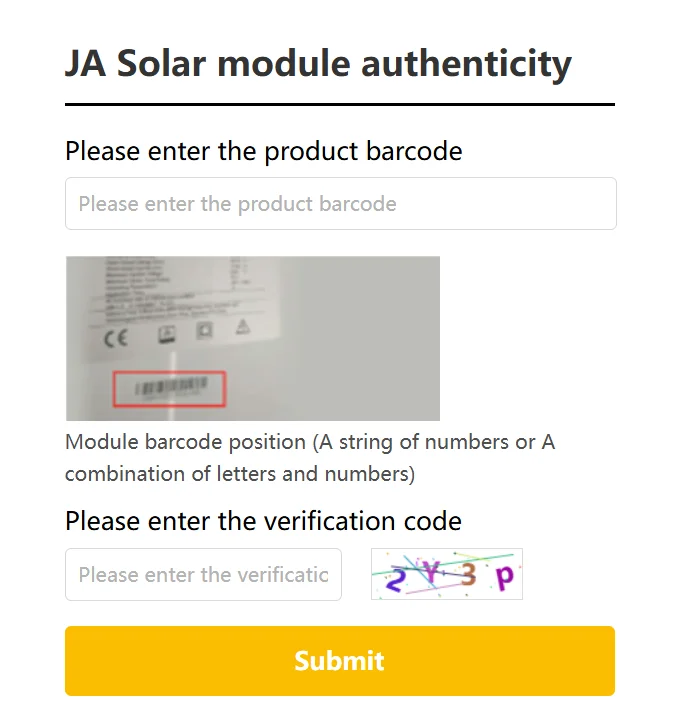
No published format, so expect no particular length or prefix. It is not the model number, which is shorter and shared by thousands of panels.
Bar code is present on the white label on the back of the solar panel, below the certification marks.
The product barcode and a verification code.
Worth knowing JA Solar accepts digits or a mix of letters and digits, which they say on the form itself, so there is no format to check before you submit. There is a verification code too, a distorted picture rather than plain digits. Be careful with the address: the real checker is product.jasolar.com, a subdomain of their own site. A near identical copy of it sits at product-jasolar.com, with a hyphen, and that one answers out of its own code rather than any database.
product.jasolar.comJA Solar’s own site. A real JA Solar check happens here and nowhere else.
product-jasolar.comDespite the name, nothing here runs on JA Solar’s servers. A checker nobody but its owner controls can return whatever answer suits its owner.
کوئی مقررہ فارمیٹ شائع نہیں کیا گیا، اس لیے کسی خاص لمبائی کی توقع نہ رکھیں۔ یہ ماڈل نمبر نہیں ہے۔ ماڈل نمبر چھوٹا ہوتا ہے اور ہزاروں پینلز پر ایک جیسا ہوتا ہے۔
بار کوڈ سولر پینل کی پشت پر لگے سفید لیبل پر، سرٹیفکیشن کے نشانات کے نیچے ہوتا ہے۔
پروڈکٹ بار کوڈ اور ایک تصدیقی کوڈ۔
جاننے کی بات JA Solar ہندسے بھی قبول کرتا ہے اور حروف کے ساتھ ملے ہوئے بھی، یہ بات وہ خود اپنے فارم پر لکھتے ہیں، اس لیے بھیجنے سے پہلے جانچنے کے لیے کوئی مقررہ فارمیٹ نہیں۔ ایک تصدیقی کوڈ بھی ہے، جو سادہ ہندسوں کے بجائے ایک دھندلی تصویر میں ہوتا ہے۔ پتے کا خاص خیال رکھیں: اصل چیکر product.jasolar.com ہے، جو ان کی اپنی ویب سائٹ کا حصہ ہے۔ اس کی ہو بہو نقل product-jasolar.com پر موجود ہے، درمیان میں ڈیش کے ساتھ، اور وہ کسی ڈیٹابیس کے بجائے اپنے ہی کوڈ سے جواب دیتی ہے۔
product.jasolar.comJA Solar کی اپنی ویب سائٹ ہے۔ JA Solar کی اصل تصدیق صرف یہیں ہوتی ہے، کہیں اور نہیں۔
product-jasolar.comنام کے اعتبار سے یہ ویب سائٹ JA Solar کی آفیشل ویب سائٹ معلوم ہوتی ہے، لیکن حقیقت میں اس کا تعلق JA Solar کمپنی سے نہیں ہے۔
One character between the real check and a fake one
JA Solar’s own checker lives at product.jasolar.com. A dot, because it is part of jasolar.com, the way a room is part of a house.
There is another site at product-jasolar.com. A hyphen, because it is not part of jasolar.com at all. It is a separate address that somebody else registered, and the only visible difference between the two is that one punctuation mark.
This is not a theoretical worry. We had the hyphenated address listed as the official one on this very site until 2 October 2026. It was wrong, a reader sent us the correct link, and checking why it was wrong turned up something worth telling you about.
What the copy actually does
The hyphenated site has reproduced JA Solar’s page line for line. The same heading, the same field labels, the same note about the barcode being numbers or a combination of letters and numbers. Its footer even carries JA Solar’s copyright and reprints JA Solar’s own Chinese government registration number, which belongs to JA Solar and not to whoever built the copy.
Underneath, it is a single static page. Its own code makes no network requests of any kind. There is no database behind it and nothing for it to ask. It generates its verification code locally with a random number, and then it applies one rule: if your serial begins with the letters zx followed by fourteen digits, it tells you the panel is genuine. Anything else is rejected as invalid.
It also reports the sales region your panel was destined for. That figure is simply the country you picked from its own dropdown, handed back to you.
So it will confirm a panel that does not exist, and refuse a real JA Solar whose serial happens not to start with those two letters. It is not a check. It is a page that produces the appearance of one.
How to tell them apart in one second
Look at the character immediately before the word jasolar. A dot means you are inside JA Solar’s own website. A hyphen means you are on a different website that has chosen a name designed to be mistaken for theirs.
The same trick is used against Jinko, where cs.jinkosolar.com is real and cs-jinkosolar.com is not. Once you have seen it, you will spot it everywhere.
Finding the barcode on your panel
JA Solar prints it on the white label on the back of the module, below the row of certification marks such as the CE mark and the recycling symbol. The photo on their own form, shown further down this page, marks the exact barcode with a red box.
Take the number from the module itself rather than from a pallet sticker or a delivery note. Those get reprinted by hand along the way, and a mistyped sticker produces a failed check on a perfectly genuine panel.
Numbers, or numbers and letters
JA Solar says on the form itself that the barcode is either a string of numbers or a combination of letters and numbers. Both are normal. There is no published length and no prefix rule, so there is nothing you can check before you submit it.
That is worth holding onto after reading the section above. The copy rejected anything not starting with zx. JA Solar themselves publish no such rule, which tells you the rule was invented by whoever built the copy.
Checking it on JA Solar’s website, step by step
Step 1: open the real form
The button at the top of this page goes to product.jasolar.com, which opens the form directly. No account, no sign in. Before you type anything, look at the address bar and check the character before jasolar is a dot.
Step 2: type the barcode
One field, labelled Please enter the product barcode. Type it exactly as printed, including any leading zeros, and keep letters as letters.
There is no country to choose. JA Solar asks for the barcode and the verification code and nothing else about you. If a page calling itself JA Solar asks you for your country, look at the address again.
Step 3: read the verification code, then Submit
Beside the second field is a short code shown as a distorted coloured picture. Copy it into the box and press the yellow Submit button.
Reading it on a phone in bright sunlight next to a pallet is genuinely awkward, so this is a job better done sitting down with the serial written out, or with a photograph of the label you can zoom into.
If JA Solar cannot find your barcode
Work through these in order. The first two account for most of what we see.
- You are on the copy, not the real site. Check the character before jasolar in the address bar. A hyphen is the wrong site.
- A character was misread. Letters and digits together make this easy. The usual culprits are a capital O read as a zero, a capital I read as a one, and the digit 5 read as an S. Check it against the label character by character.
- You read the model number. A JA Solar model number looks like JAM72D40-575/LB and describes the product. Thousands of panels share it. The barcode is unique to your module.
- The verification code was wrong. It will refuse rather than tell you the barcode is bad, so load a fresh code and try again before concluding anything.
- The batch has not been loaded yet. Very recent production can lag the public database.
- The panel is not a JA Solar. Reach for this last, once the five above are genuinely ruled out, and only after checking several modules rather than one.
If a barcode you have checked carefully still fails on the real site, take barcodes from three or four panels across different pallets before you say anything to the seller. One failure is a typo. A whole pallet failing is a finding, and that is the point at which to photograph the labels and contact JA Solar directly.
Why the imitation sites exist
The reasoning is the same everywhere. A verification page that nobody controls but its own operator can return whatever answer suits that operator, and the answer that suits is genuine. A buyer who checks a counterfeit panel on a site like that walks away reassured, which is exactly what the seller wanted. The site costs almost nothing to run and it does not need to fool you for long.
JA Solar’s copy is the clearest example we have found, because we can say precisely what it does rather than only where it is hosted. Most of the others we judge by their hosting: checking them one day apart in October 2026, every rotating imitator had changed machine overnight, and every one had moved within the same small pool of addresses. Sites claiming to speak for different manufacturers, drawing from one pool and rotating daily, is one operator running all of them. The detail is on the verification hub.
The rule is short enough to carry: a real JA Solar check happens on product.jasolar.com, with a dot, and nowhere else.
What a JA Solar pass does and does not prove
A match on the real site means JA Solar has that barcode in its production records and the module is theirs. That is worth having, and a panel assembled in a workshop will not have one.
It does not tell you the panel is A grade, because manufacturers record downgraded modules too and a genuine B grade panel passes. It does not tell you the module is undamaged, because microcracks from rough transport do not change a barcode. It does not tell you the warranty is yours, because that depends on the channel the panel was sold through. And it does not tell you the output matches the label, which only a flash test can settle.
Treat a pass as proof of origin. Everything else is a separate conversation with your supplier.
Common questions about JA Solar verification
Is product-jasolar.com run by JA Solar?
No. JA Solar’s own checker is at product.jasolar.com, with a dot, on the same content network as jasolar.com itself. The hyphenated address is a separate site hosted on a developer platform, with JA Solar’s copyright and registration number copied into its footer. It holds no data and makes no enquiries. We listed it as the official address ourselves until 2 October 2026, which is exactly how convincing it is.
How long is a JA Solar barcode?
They do not publish a length. Their form says it is either numbers, or letters and numbers together. That means there is nothing to check before you submit it, which is the opposite of Jinko, where 24 digits is a published rule you can test against.
Do I have to pick a country?
Not on the real site. JA Solar asks for the barcode and the verification code only. The copy does ask for a country, and then quotes it back to you as the sales region the panel was destined for, which is one of the clearest signs that it is not asking anybody anything.
Do I need a JA Solar account?
No. The authenticity form is open to anyone, with no sign in.
Should I check before installing?
Yes. The barcode is on the back of the module, so once a panel is mounted and wired you would have to take it down to read it. Check on delivery, while refusing the consignment is still an option.
The seller showed me an import sheet. Is that the same thing?
It is useful but it answers a different question. An import document proves somebody imported a quantity of panels. It only says anything about yours if the barcode ranges printed on it cover the numbers on the modules in front of you. Check two or three against the document, then verify those same barcodes on JA Solar’s own site.