How to Verify Jinko Solar Panels Online in Pakistan
Jinko is the only major manufacturer that publishes what its serial numbers look like: exactly 24 digits, no letters. Here is where to find yours, and the one address that genuinely belongs to them.
Exactly 24 digits. It is not the model number, which is shorter and shared by thousands of panels.
Serial number is present in one of the corners on the front of the solar panel, and again in the centre of the back sheet.
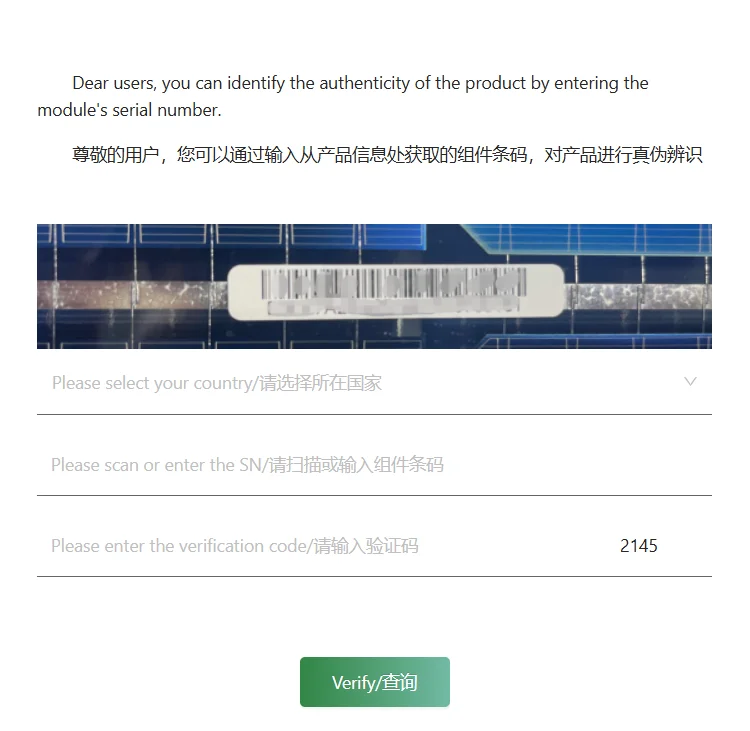
Your country, the serial number, and a captcha code.
Worth knowing Jinko is the only brand here that publishes its format: a 24 digit code. The form asks for your country before anything else. Pick Pakistan: the list is long, alphabetical, and does not filter as you type, so scroll to it. There is a captcha as well. The country is not a formality. Jinko answers with the sales region the module was sold into, and a genuine panel brought in outside their official channel is reported in the same words as a counterfeit, so read what the answer says rather than only whether it passed.
cs.jinkosolar.comJinko’s own site. A real Jinko check happens here and nowhere else.
jinkosolarverification.comDespite the name, nothing here runs on Jinko’s servers. A checker nobody but its owner controls can return whatever answer suits its owner.
cs-jinkosolar.comDespite the name, nothing here runs on Jinko’s servers. A checker nobody but its owner controls can return whatever answer suits its owner.
بالکل 24 ہندسوں کا۔ یہ ماڈل نمبر نہیں ہے۔ ماڈل نمبر چھوٹا ہوتا ہے اور ہزاروں پینلز پر ایک جیسا ہوتا ہے۔
سیریل نمبر سولر پینل کے اگلے حصے پر کسی ایک کونے میں، اور پچھلی شیٹ کے درمیان میں بھی موجود ہوتا ہے۔
آپ کا ملک، سیریل نمبر، اور ایک کیپچا کوڈ۔
جاننے کی بات Jinko واحد برانڈ ہے جو اپنا فارمیٹ شائع کرتا ہے: 24 ہندسوں کا کوڈ۔ فارم کسی بھی چیز سے پہلے آپ کے ملک کے بارے میں پوچھتا ہے، اور یہیں سے لوگ غلط ہو جاتے ہیں۔ پاکستان کا انتخاب کریں۔ فہرست لمبی، حروف تہجی کے مطابق ہے، اور آپ کے ٹائپ کرتے وقت فلٹر نہیں ہوتی، اس لیے اس پر سکرول کریں۔ ایک captcha بھی ہے۔ ملک کا انتخاب صرف رسمی بات نہیں۔ Jinko جواب میں وہ سیلز ریجن بتاتا ہے جہاں پینل فروخت ہوا تھا، اور جو اصلی پینل ان کے سرکاری چینل سے باہر درآمد ہوا ہو، اس کا جواب بھی نقلی پینل جیسے الفاظ میں آتا ہے۔ اس لیے صرف یہ نہ دیکھیں کہ تصدیق ہوئی یا نہیں، جواب کے الفاظ پڑھیں۔
cs.jinkosolar.comJinko کی اپنی ویب سائٹ ہے۔ Jinko کی اصل تصدیق صرف یہیں ہوتی ہے، کہیں اور نہیں۔
jinkosolarverification.comنام کے اعتبار سے یہ ویب سائٹ Jinko کی آفیشل ویب سائٹ معلوم ہوتی ہے، لیکن حقیقت میں اس کا تعلق Jinko کمپنی سے نہیں ہے۔
cs-jinkosolar.comنام کے اعتبار سے یہ ویب سائٹ Jinko کی آفیشل ویب سائٹ معلوم ہوتی ہے، لیکن حقیقت میں اس کا تعلق Jinko کمپنی سے نہیں ہے۔
Finding the serial number on your panel
Jinko prints it twice. Once in one of the corners on the front of the module, where it sits in the white margin beside the glass, and again in the centre of the back sheet. The two should read the same. If they do not, photograph both before you go any further, because that by itself is worth raising with the seller.
Take it from the module, not from a pallet sticker or a delivery note. Those get reprinted by hand at various points between the factory and your roof, and a mistyped sticker produces a failed check on a perfectly genuine panel.
Twenty four digits, and nothing else
This is the one brand where you can check the shape of the number before you check the number itself. A Jinko serial is 24 characters long and every one of them is a digit. If what you are holding contains a letter, you are reading something else, most likely the model number.
A Jinko model number looks like JKM580N-72HL4-BDV and describes the product: the series, the cell count, the wattage. Thousands of panels share it. The serial is unique to your single module, it is longer, and it is all numbers.
The tool at the top of this page counts the characters for you and tells you if the length is wrong before you take it anywhere.
Checking it on Jinko’s website, step by step
Step 1: open the form, not the support hub
This is where most people lose ten minutes. Jinko’s checker lives inside a larger customer service portal at cs.jinkosolar.com, and the front page of that portal offers four things, of which SN Authentication is one. Press its Search button and you are sent to a sign in screen asking for an account you do not have and do not need.
The form itself opens without any account. The button at the top of this page goes straight to it, which is the simplest way to avoid the detour. Jinko’s own European site links to exactly the same form, so if you have arrived from there you are already in the right place.
Step 2: pick Pakistan from the country list
The form asks for your country before it asks for anything else, and the country is not a formality. It decides which answer you get, which the next section explains.
Two things are worth knowing before you start scrolling. The list is alphabetical and runs to every country in the world, and it does not filter as you type, so typing “Pak” will not jump you there. You have to scroll down to P. The entry reads Pakistan followed by the Chinese characters for it, because the whole form is bilingual.
Step 3: enter the serial and the code
The second field takes the 24 digit serial. Type it exactly, including any leading zeros.
The third field is a verification code: four digits shown at the end of the row, which you copy into the box. It is worth knowing this is there before you try the check one handed on a phone, standing next to a pallet in a warehouse. Then press Verify.
What Jinko’s answer actually tells you
Most manufacturers answer yes or no. Jinko answers in three ways, and it publishes all three on its own site. The difference between them is the country you picked, and it is worth understanding before you read your result.
- Genuine, and sold into the country you chose. The module is Jinko’s, and the warranty and after sales service apply within that country and the wider sales region it belongs to.
- Genuine, and sold into a different country in the same sales region. Still Jinko’s, still covered, but the message names the country it was actually destined for rather than yours.
- Not covered. Jinko’s wording here is the one to read carefully, because it covers two very different situations in one sentence: a serial that is not a genuine Jinko product, or one that reached the market through an unofficial sales channel. Either way the module is outside their limited warranty.
That third outcome deserves attention in Pakistan, because a great deal of stock arrives here through channels Jinko has not appointed. A module that came in that way is a real Jinko, built in a real Jinko factory, and it will still return the same message as a counterfeit. The glass on your roof is genuine; the warranty behind it is not.
So read the words, not just the colour of the result. A serial reported as not genuine and one reported as having entered through an unofficial channel are a very different conversation with your supplier, and the message tells you which one you are having.
If Jinko cannot find your serial
Work through these in order. The first three explanations account for almost everything we see.
- A digit is missing or added. Twenty four is a lot of digits to copy without losing one. Count them, then read it back against the module.
- You read the model number. If it contains a letter, it is not the serial.
- The country was left unset. The form will not search without one.
- The batch has not been loaded yet. Very recent production can lag the public database.
- The panel came through an unofficial channel. See the section above. This is a warranty problem, not necessarily a counterfeit one.
- The panel is not a Jinko. Reach for this last, once the five above are genuinely ruled out, and only after checking several modules rather than one.
If a serial you have checked carefully still comes back badly, take serials from three or four panels across different pallets before you say anything to the seller. One failure is a typo. A whole pallet failing is a finding, and that is the point at which to photograph the labels and contact Jinko directly through the same portal.
Why the imitation sites exist
Jinko attracts more imitation checkers than any other brand on this site, which is unsurprising given how much Jinko stock moves through Pakistan. The real address and the ones copying it are listed near the top of this page.
The reasoning behind them is simple. A verification page that nobody controls but its own operator can return whatever answer suits that operator, and the answer that suits is genuine. A buyer who checks a counterfeit panel on a site like that walks away reassured, which is exactly what the seller wanted. The site costs almost nothing to run and it does not need to fool you for long.
We re-check where these sites are hosted. Between our September and October 2026 checks, the fake Jinko page, the fake LONGi page and a site offering to check every brand at once all moved to new machines, and all moved onto the same handful of address ranges as each other. Three sites claiming to speak for three different manufacturers, changing hosts in step, is one operation. The detail is on the verification hub.
The rule is short enough to carry: a real Jinko check happens on cs.jinkosolar.com and nowhere else.
What a Jinko pass does and does not prove
A match means Jinko has that serial in its production records and the module is theirs. That is worth having, and a panel assembled in a workshop will not have one.
It does not tell you the panel is A grade, because Jinko records downgraded modules too and a genuine B grade panel passes. It does not tell you the module is undamaged, because microcracks from rough transport do not change a serial number. And it does not tell you the output matches the label, which only a flash test can settle.
What Jinko’s check does tell you, which most do not, is whether the warranty follows the panel. That is the point of the country field, and it is the most useful thing on the form.
Common questions about Jinko verification
How long is a Jinko serial number?
Exactly 24 digits. Jinko is the only manufacturer on this site that publishes a format, which is why this is the one brand where a wrong length tells you something before you have checked anything. The tool at the top of this page counts for you.
Is jinkosolar.eu a different checker?
No. JinkoSolar’s European site has a page explaining the tool and setting out the three possible outcomes, and both of its buttons link to the same form on cs.jinkosolar.com that this page sends you to. There is one checker, not a European one and a global one. If a seller has sent you a jinkosolar.eu link, it is legitimate and it lands in the same place.
Do I need a Jinko account?
No. The sign in screen you may have hit belongs to the wider service portal, used for warranty claims and similar. The authenticity form itself is open to anyone. The button at the top of this page goes to the form, not the portal front page.
Can I scan the barcode instead of typing it?
The field is labelled for scanning or typing, so a barcode scanner works if you have one. A phone camera app may also read it. Either way, check what it produced against the printed digits before you submit, because a misread on 24 digits is easy and the result looks identical to a counterfeit.
Why is the form half in Chinese?
Jinko is a Chinese manufacturer and the page is bilingual throughout: every label carries the English and the Chinese together. It is not a sign you are on the wrong site. Check the address bar reads cs.jinkosolar.com and carry on.
Should I check before installing?
Yes. The serial is in a front corner and on the back sheet, so once a panel is mounted and wired you would have to take it down to read it. Check on delivery, while refusing the consignment is still an option.
The seller showed me an import sheet. Is that the same thing?
It is useful but it answers a different question. An import document proves somebody imported a quantity of panels. It only says anything about yours if the serial ranges printed on it cover the numbers on the modules in front of you. Check two or three against the document, then verify those same serials on Jinko’s own site.